How to practice sound meditation as a self-care technique
Categories:
Share this article!


How to practice sound meditation as a self-care technique
Sound meditation, as a tool for relaxation and self-care, is both accessible and versatile. We can practice in a group or solo, with the help of a facilitator or simply by listening to a guided session. In this part, we will explore in detail how to integrate this practice into your daily life, using different tools and instruments to improve your general well-being.
Getting ready for a sound meditation session
Before starting a sound meditation session, it is essential to create an environment conducive to relaxation. A quiet space, away from distractions, is ideal for fostering a state of deep relaxation. You can also add elements that stimulate relaxation, such as candles, essential oils (lavender, eucalyptus), or dim lighting. If you have access to a fireplace or a warm bath, these elements can also intensify the feeling of cocooning, especially during cooler seasons such as autumn.
The instruments used in sound meditation
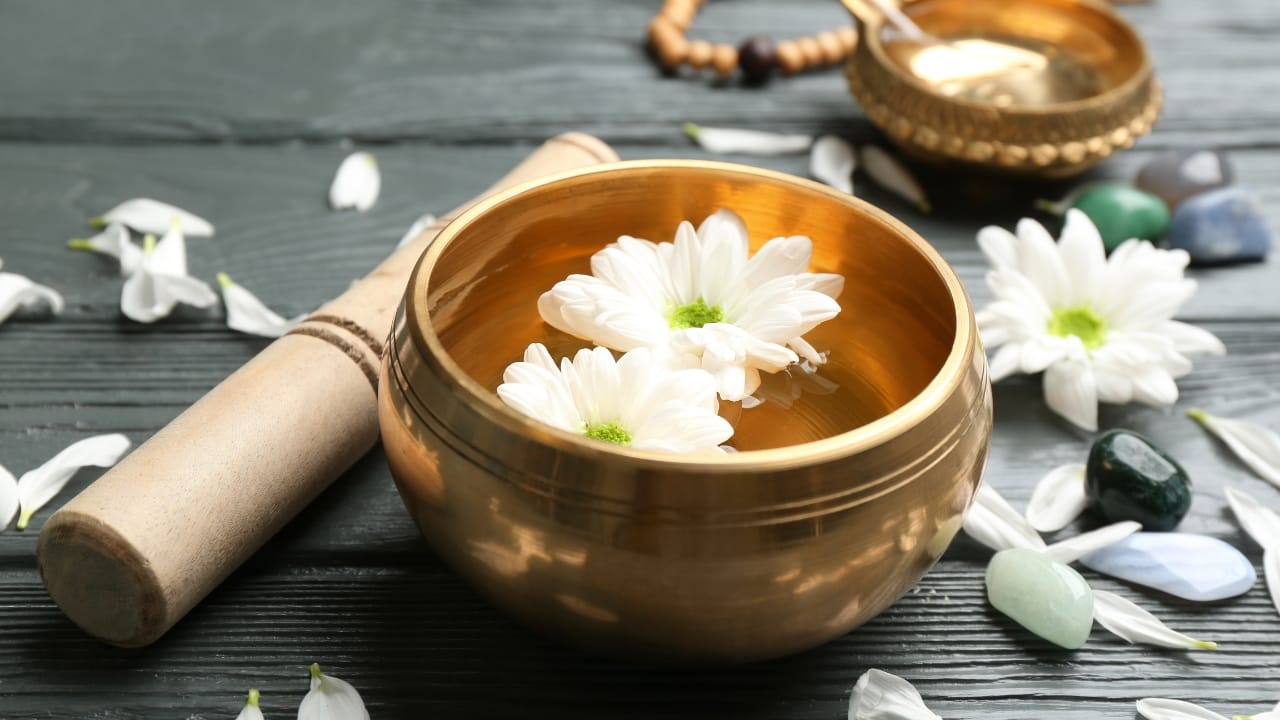
The instruments used in sound meditation are central to the practice. They produce sound vibrations that are not only perceived by our ears but also resonate throughout our bodies. Tibetan singing bowls, gongs, chimes, and even the human voice play an essential role in this form of meditation. These instruments create specific frequencies that have a direct impact on the nervous system, helping to reduce stress and harmonize mind and body.
Here are some of the most commonly used instruments:
- Tibetan singing bowls: These bowls produce rich harmonic sounds and are often used to balance the chakras or energy centers of the body.
- Gong: The gong emits a powerful and immersive sound that envelops the entire space, creating a sensation of total immersion.
- Drums: Used in some traditions, they produce a regular beat that helps anchor the meditator.
- Chimes and bells: These small instruments emit clear and sharp sounds, often used to mark transitions during meditation.
✨My practical advice
If you do not have these instruments available, there are many applications and online platforms, such as YouTube, where you can find recordings of sound meditations. Platforms like Insight Timer and Calm also offer a variety of guided meditations based on specific sounds and vibrations. You can also use headphones for a more immersive experience.
How to practice sound meditation: step by step

- Find a quiet and comfortable place:
Whether you are inside or outside, the important thing is to feel comfortable and undisturbed. You can sit cross-legged on a meditation cushion, lie down, or even sit in a chair.
- Use headphones for an immersive experience:
If you are using a prerecorded sound meditation, headphones can help you to perceive sounds better and block out outside distractions.
- Breathe deeply:
Conscious breathing is a key element of sound meditation. Start by taking long, deep breaths to refocus. When you listen to sounds, focus on the sensation of vibrations in your body. - Focus on the sounds:
In the session, let the sounds guide you. If your mind begins to wander, gently bring your attention back to the sounds or breathing. The vibrations of the bowls or gong will help you stay grounded. - Let the vibrations act on your body:
The sounds produced by the Tibetan singing bowls, for example, create vibrations that resonate in your body. Some practitioners feel these vibrations at the level of their solar plexus or their chest, while others perceive them throughout their body.
- Take the time to come back slowly:
When the session ends, do not rush to return to your daily activities. Take a few minutes to assess how you are feeling. Slowly, move your fingers, feet, and open your eyes when you’re ready.
Suggestions for integrating sound meditation into your self-care routine

Sound meditation can be a powerful practice for promoting relaxation and inner healing, but it is essential to integrate it into your self-care routine regularly. Here are some suggestions to maximize the benefits of this practice:
- Meditate regularly:
You don’t need to meditate for hours every day. Even short sessions of 10 to 15 minutes can have a significant impact. Try to meditate early or late in the day to balance your mind.
- Combine sound meditation with other techniques:
For enhancing the effects, you can combine sound meditation with breathing exercises or yoga postures. The practice of Nidra yoga, for example, blends well with the sounds of Tibetan singing bowls. - Use sound meditation for sleep:
If you have difficulty falling asleep, try a sound meditation before bedtime. It helps to calm your mind and prepare your body for a restful sleep. - Practice with a group:
Participate in group sound baths. The collective experience can be more effective because the sound vibrations resonate throughout the space, creating a complete immersion. - Try different forms of sound meditation:
It exists many ways to explore sound meditation. You can experiment with different instruments like flutes, drums, or even therapeutic tuning forks. Each sound or vibration produces a unique experience.
My experience with sound meditation

During my first sessions, I noticed how the environment plays a key role in the meditation experience. I had the opportunity to practice in various places. I particularly remember a session in Oka, Quebec, where the surrounding nature and the calm of sounds helped me relax more deeply. The sound bath I experienced there, led by Gaëlle Cosnuau, truly resonated with me, giving me a sense of inner peace that I had never felt before.
Sound meditation is a great way to refocus when feeling scattered or stressed. The sounds of the Tibetan singing bowls allow me to relax and let go of negative thoughts deeply. I particularly appreciate the collective meditation sessions because the energy of the other participants amplifies the relaxing effect of the sound vibrations. However, even in solo, this practice helps me manage stress and find a space of inner calm.
A sound bath or a sound meditation near you
You can consult the Web to find a practitioner of sound meditation who offers in-person sound baths. The range of physical sounds is much more efficient since the vibratory physical waves are in contact with the entire body and not only through the auditory pathway. This one is valid, but it does not go as deep into the whole physical body and mind.
As mentioned, I had the opportunity to experience the sound bath and sound massage with Gaëlle Cosnuau. It offers workshops, retreats, training, and other services related to yoga, alternative therapies, including sound therapy, individual sound massage, meditation, and group sound bath. You can see all its services on its website: https://www.gaellecosnuau.ca/.
Here is a link to see and hear one of her videos in which she offers a sound bath: https://youtu.be/fkWqB1Cp908.
Conclusion
Sound meditation is a simple but powerful practice for those seeking to improve their mental and physical well-being. Whether you choose to meditate with singing bowls, gongs, or simply sound recordings, the benefits of this practice are vast. By integrating it into your self-care routine, you can reconnect with yourself, balance your energy, and reduce stress. Try it for yourself, and let the soothing vibrations transform your daily life.
To start your experience
To start your experience, there are several videos on YouTube that you can listen to or watch. You can type ‘sound meditation or bath of sounds’, in English ‘sound meditation’ or ‘bath meditation’. Here are some examples below.
Yin Healings: https://youtu.be/NsFhVJzOD-k
Silence sonore: https://youtu.be/fONj_JFEOHs
Sandra Insoha: https://youtu.be/-ffoM2L_p0Y
Gaia Meditation: https://youtu.be/CFCcZdXXSVI
The voice in resonance: https://youtu.be/duZKBuauTzM
Mental waves officiel: https://youtu.be/iSbAsC4bYoU
Jessica Richburg: https://youtu.be/unCya_-8ECs
Healing Vibrations: https://youtu.be/pcoXfD3PtTY
I hope this article has inspired you to try sound meditation.
For other self-care techniques, you can refer to this article: Self-Care Techniques: Taking Care of Yourself Daily